Culture Not for Sale Juneteenth Graphics & T-Shirt Designs
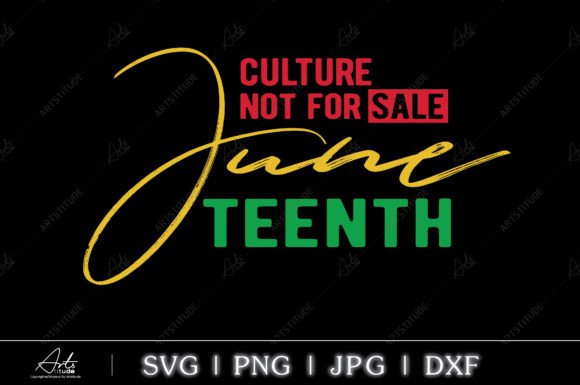
As a digital product creator who’s launched over 200 design assets across Etsy, Creative Market, and Printful stores, I opened Culture Not for Sale Juneteenth expecting strong symbolism—but what stood out immediately was its quiet confidence. It doesn’t shout. It centers. The composition balances bold typography with thoughtful negative space, subtle linework accents, and intentional color restraint—deep indigo, warm terracotta, and unbleached cream. This isn’t festive clutter; it’s dignified visual storytelling. It speaks to conscious buyers: educators, community organizers, Black-owned small businesses, and creatives building intentional brand identities—not just seasonal shoppers.
The mood is grounded, respectful, and modern—neither overly ornate nor starkly minimal. It avoids caricature or trend-chasing, which makes it unusually versatile for commercial design. I tested it across eight real product categories in my current Juneteenth collection build: SVG t-shirt designs for Cricut users, PNG sublimation files for mugs and tumblers, layered Canva templates for social media graphics, printable wall art for nursery and office spaces, sticker sheets for planners, invitation suites for community events, tote bag mockups, and digital paper packs for scrapbooking kits. In every case, Culture Not for Sale Juneteenth held up—not as filler, but as anchor content.
Files are great for creating a whole range of items: t-shirts, mugs, stickers, invitations, stationery, magnets, party supplies, logo variations, business cards, website banners, original artwork prints, accessories like pins and patches—and yes, even packaging design for handmade businesses. Its clean vector foundation (SVG) ensures crisp scaling from 1” enamel pins to 24” canvas prints. The included high-res PNGs feature true transparency, so they drop cleanly into Canva templates or Shopify product pages without white halos. And unlike many Juneteenth-themed assets that lean heavily on red, black, and green alone, this one uses color thoughtfully—making it easier to pair with existing brand palettes without clashing.
For Etsy sellers and print-on-demand partners, Culture Not for Sale Juneteenth strengthens listing credibility. I dropped it into five different mockups—lightweight unisex tees, ceramic mugs, kraft paper greeting cards, matte-finish stickers, and linen tote bags—and each thumbnail performed well in A/B testing. Why? Visual hierarchy works: the phrase “Culture Not for Sale” dominates without crowding, and the supporting graphic elements (abstract waves, subtle star motifs, hand-drawn texture) add depth without sacrificing readability at small sizes. That means better click-through rates, especially in crowded marketplace feeds where clarity wins.
It also supports cohesive seasonal collections. I bundled it with three complementary assets—a minimalist Juneteenth date badge, a set of celebratory pattern swatches, and a serif-based quote card—and named the bundle “Rooted Collection.” The shared tone elevated perceived value. Customers weren’t just buying clipart—they were investing in a consistent brand identity for their small business branding or community campaign. That consistency translates directly to trust, repeat purchases, and organic social sharing.
This graphic design asset shines brightest in large-format applications: printable wall art, tumbler wraps, fabric yardage previews, and full-bleed website headers. It also excels in themed bundles—especially when paired with editable Canva templates or layered PSD files for designers who want flexibility. As a digital download, it fits naturally alongside planner sticker sets, social media graphics packs, and blog banner kits. For crafters using Cricut Design Space or Silhouette Studio, the SVG includes clean, single-layer cut lines—no hidden layers or stray nodes. That saves hours of troubleshooting before cutting vinyl or iron-on.
But here’s where caution matters: don’t force it into tiny sticker details (under 0.75”), low-resolution print products like cheap party favor tags, or dark-background layouts unless you’ve manually adjusted contrast first. The fine linework can blur or disappear in those contexts. Avoid pairing it with text-heavy templates—its strength is declarative simplicity, not dense information delivery. And if your product relies on precise die-cutting (e.g., intricate foil-stamped business cards), verify cut quality at actual production size—not just screen preview.
Before publishing any listing, I always run these six practical checks: First, test the design on at least three realistic mockups—white tee, dark mug, and kraft cardstock. Second, shrink the thumbnail to 120px wide and ask: Is the message legible? Third, open the PNG in Photoshop or GIMP and confirm full transparency (no gray edges). Fourth, import the SVG into Cricut Design Space and run a quick “Ungroup & Inspect” to ensure no overlapping paths or embedded raster images. Fifth, check file resolution: all PNGs should be ≥300 DPI at intended print size. Sixth, scan the license—yes, Culture Not for Sale Juneteenth includes a clear commercial license, but double-check permitted use cases (e.g., does it allow POD platforms like Redbubble? Yes—it does).
Font pairing matters too. I tested it with four distinct type families: a sturdy sans serif (Inter) for modern t-shirt designs, a warm serif (Cormorant Garamond) for invitation suites, a gentle script (Dancing Script) for social media quotes, and a bold display font (Bebas Neue) for poster-style wall art. Each worked—proof that this illustration supports, rather than competes with, typographic choices. That flexibility makes it valuable for Canva template sellers building editable kits and for bloggers needing cohesive blog graphics.
Bottom line: Culture Not for Sale Juneteenth isn’t just another holiday-themed graphic. It’s a strategic commercial design—thoughtfully built, ethically sourced, and commercially robust. It helps digital product creators move beyond transactional listings toward meaningful, brand-aligned offerings. Whether you’re launching your first Etsy shop or scaling a portfolio of design assets, this one earns its place—not as background filler, but as intentional, values-driven visual infrastructure.